This article may contain affiliate links. As an Amazon Associate, we may earn from qualifying purchases at no extra cost to you.
Roadside Survival: Cones, Triangles, and Flares, Building Your Safe Buffer
Roadside Survival: Cones, Triangles, and Flares, Building Your Safe Buffer
🎯 Objective
It’s dusk, traffic is flying by at 70 mph, and you’re on the shoulder with nothing but your hazard lights. One wrong glance at a phone, one second of inattention, and a driver is in your space. Cones, triangles, and flares aren’t just gear, they’re your shield. This talk shows how to use them to turn a deadly roadside into a survivable work zone.
⚠️ Key Hazards
-
Distracted or impaired drivers swerving into the shoulder.
-
Limited sight distance from fog, curves, or blind hills.
-
Tiny cones or sloppy spacing that create false confidence.
-
Flares sparking fires near spilled diesel, grass, or brush.
-
Secondary crashes when motorists don’t see your warning zone until too late.
🛠️ Best Practices for Survival Set-Up
-
Read the Scene: Step one is survival awareness, check traffic speed, road width, and blind spots before opening the door.
-
Vehicle as a Shield: Park with flashers on, steer wheels away from traffic, and angle your truck if it can protect you.
-
Deploy Cones & Triangles Like a Pro:
-
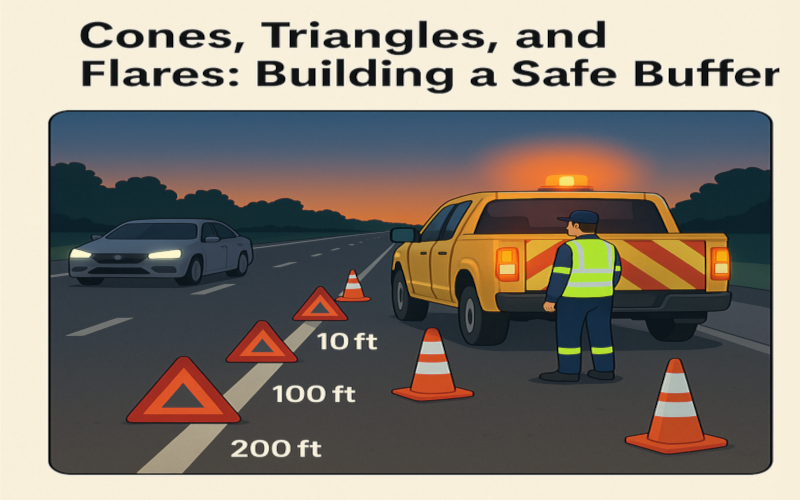
Place the first at 10 feet, then at 100 feet and 200 feet behind your vehicle (per FMCSA 49 CFR §392.22).
-
On curves, hills, or low-visibility areas, stretch them out to 500 feet. Think of it as buying time, every 100 feet is another second for a driver to react.
-
Use 28-inch cones with reflective collars, anything smaller disappears in headlights.
-
Triangles fold flat and fit in any roadside kit, keep them in your rig, camper, or service truck.
-
Flares with Caution: Only strike when safe. Never near spilled fuel, dry grass, or brush. When safe, space them like triangles for nighttime punch.
-
Layer Your Visibility: Hazards on, roof beacon if equipped, reflective vest on your back, cones/triangles on the ground. The more layers, the better.
-
Constant Watch: Wind and traffic can knock cones out of place, reposition as needed. Your buffer zone is only as strong as its last check.
🛑 A Roadside Tragedy
Texas, 2021. A service tech pulled onto I-35’s shoulder for a tire change. Hazards on, tools out but no triangles, no cones. A driver, glancing down at their phone, drifted right. The impact was fatal. Investigators found that three simple warning devices could have added 10+ seconds of reaction time. Ten seconds is the difference between life and death. Don’t gamble on luck build the buffer.
✅ Call to Action
Open your roadside kit today. Do you have three reflective triangles, 28-inch cones, and safe-to-use flares? If not, replace them before your next trip. Your buffer should always be ready before the breakdown.
📋 Quick Survival Recap
-
Three warning devices, minimum.
-
Placement: 10 ft, 100 ft, 200 ft, extend to 500 ft on hills/curves.
-
Cones = 28 inches with reflective collars.
-
Flares only when fire risk is zero.
-
Combine cones, flashers, beacons, and high-viz gear for layers of safety.
Takeaway (Safety Slogan):
“Cones save bones, build the buffer before you wrench.”
📘 Survival Quiz
-
What’s the minimum size cone for roadside safety?
A) 12 in
B) 18 in
C) 28 in
D) 36 in -
How many devices (cones/triangles) should you always set?
A) 2
B) 3
C) 4
D) 5 -
On a hill or blind curve, how far back should the farthest device go?
A) 200 ft
B) 300 ft
C) 400 ft
D) Up to 500 ft -
When should you avoid using flares?
A) At night
B) Near spilled fuel or dry grass
C) On level ground
D) During rain -
What regulation sets roadside warning device rules?
A) OSHA 1910.147
B) FMCSA 49 CFR §392.22
C) DOT Part 40
D) MUTCD Section 4E
Answer Key: 1-C, 2-B, 3-D, 4-B, 5-B
📑 Compliance + Reality Check
-
FMCSA 49 CFR §392.22: Warning devices must be placed within 10 minutes of stopping.
-
MUTCD specifies cone/triangle size and reflective standards.
-
OSHA highlights struck-by hazard prevention for roadside workers.
-
AAA Foundation (2022): ~350 people are killed every year outside a disabled vehicle. That’s nearly one every day.